
Prince Obasi: The Portrait That Refuses You

Stand in front of a Prince Obasi painting at a fair and you'll do one of two things. You'll lean in, caught by the strangeness of it — or you'll look away, certain it isn't for you. Almost nobody is indifferent. We've watched it happen across a booth: one person stopped in their tracks, another already moving on, faintly affronted. That split is not a problem with the work. It's the clearest evidence the work is doing its job.
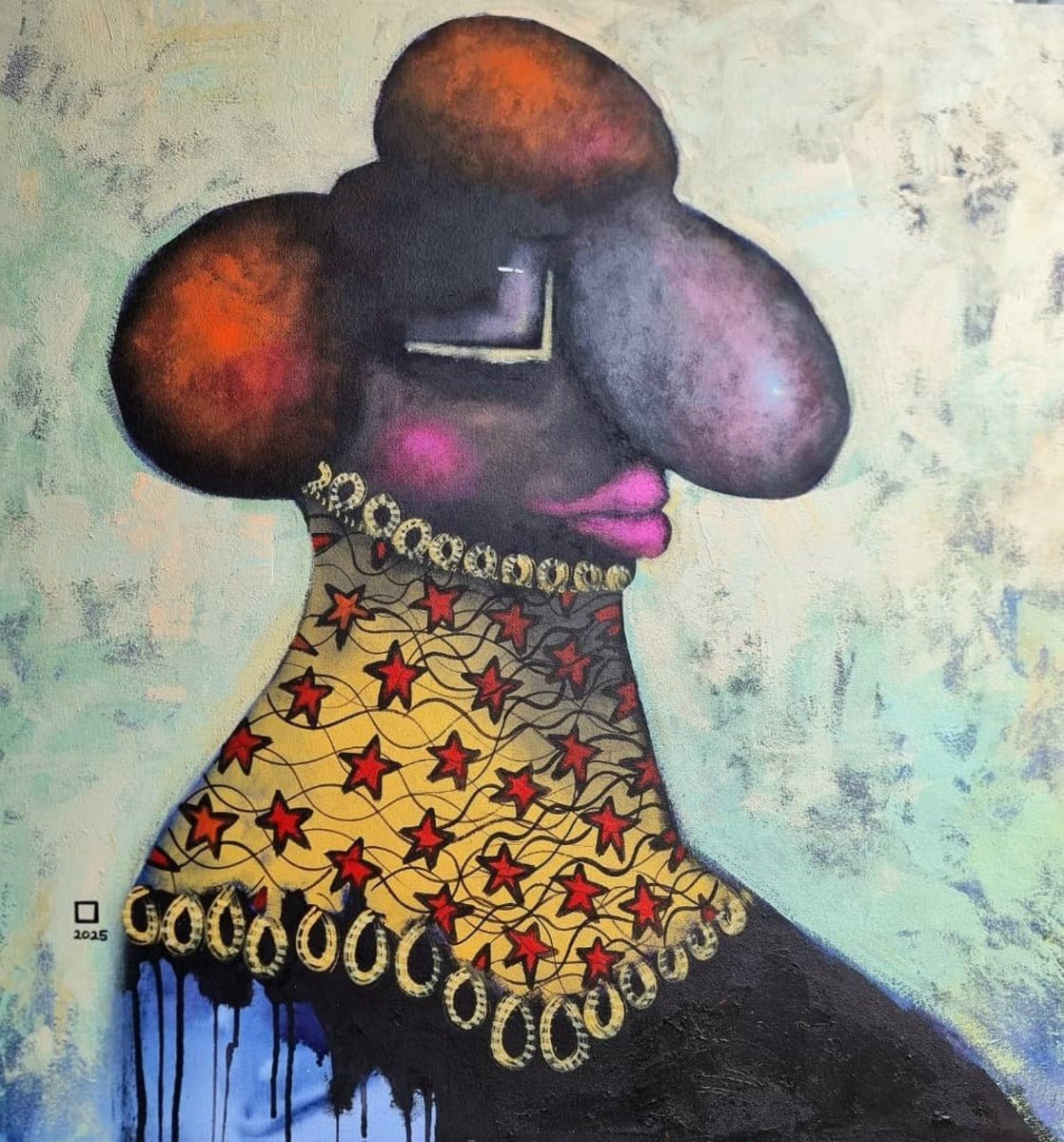
Look closely and the first surprise is how much is familiar. The frontal pose, squared to the viewer. The careful drape and fold of cloth. Antique jewellery, lace at the collar, a hand resting just so on a shoulder. These are the codes of 19th-century European bourgeois portraiture — the language a rising merchant class once used to picture itself: composed, prosperous, permanent. A portrait like that was a claim. I matter, and here is the proof, painted to last. Obasi knows that language fluently, down to its smallest gestures. He simply refuses to speak it straight.
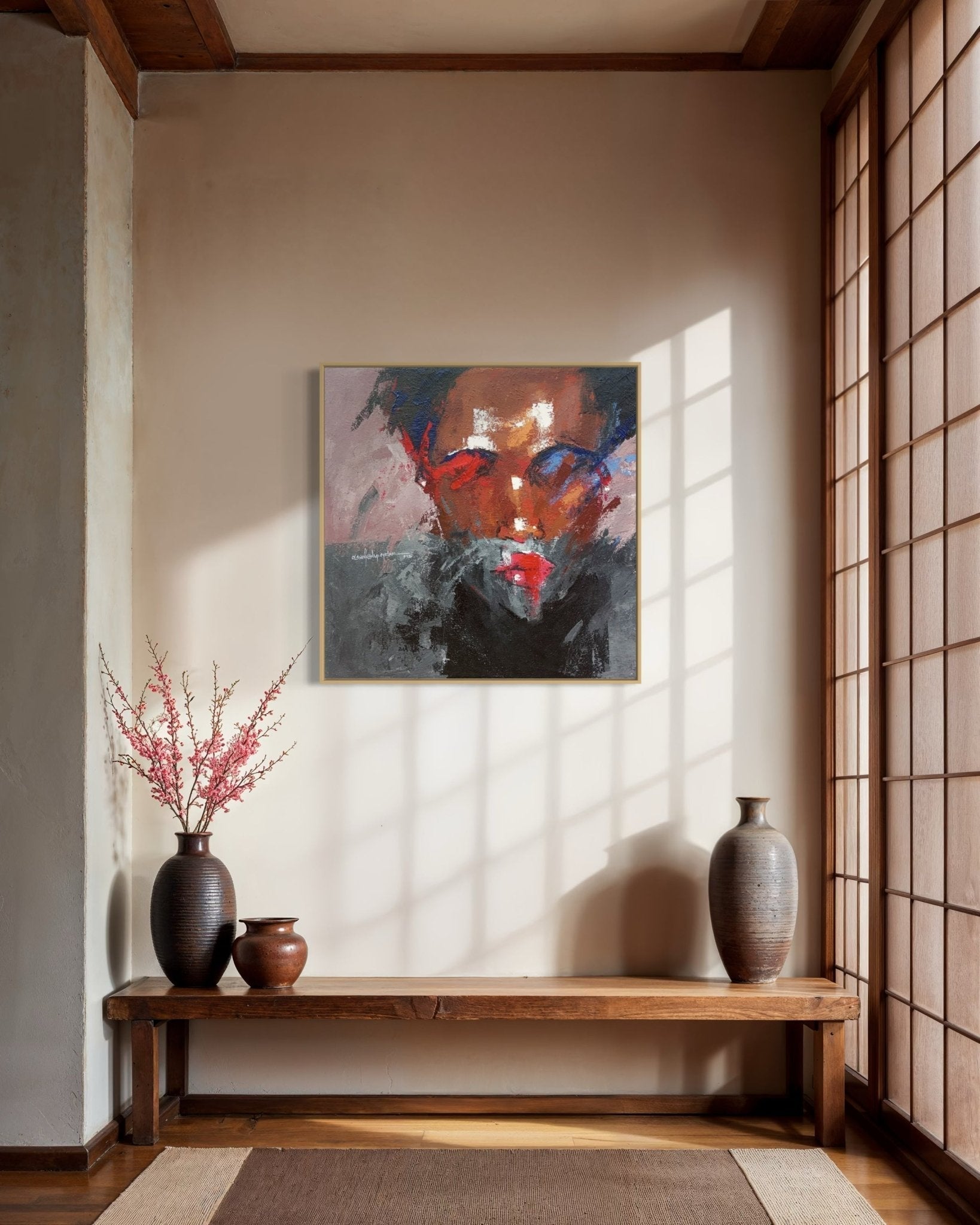
Because the face won't resolve. Features swell and flatten toward something closer to a mask; planes of bruised colour meet where you expect a cheekbone; a square eye sits in place of a likeness. This is the moment some viewers stop. A portrait, surely, is meant to look like someone. But likeness was never Obasi's concern, and the square eye is the tell. It refuses the one thing traditional portraiture promised — that you could look at the picture and recognise the person — and asks you to look for something else instead.
What it asks you to find is psychology. Obasi paints the inner weather of a sitter rather than their outline: a feeling conveyed through the tilt of a head, a flush at the cheek, a gaze that reads as tearful, or proud, or quietly unreadable. Strip away the comfort of recognition and you're left in front of pure state — and that's harder to stand before than a pretty face, which is precisely why it moves the people it moves.
That tension — classical setup, deliberate break — is the whole project, and it explains the divided room. The viewer who recoils is reading a failed likeness. What they're actually looking at is a portrait that decided not to flatter, and meant it.

The handling carries the same doubleness. Obasi sets passages of fine, deliberate detail — the cloth, the jewellery, the beaded collar — against raw, almost unfinished work elsewhere: a drip left to run, a ground left rough. The finery is rendered with the patience of a classical painter; the figure wearing it is handled like something more urgent. His themes sit close to that surface once you stop fighting the form: love, struggle, the texture of contemporary Nigerian life, dressed in another era's borrowed idea of importance.

The path to this point was unhurried, and worth knowing. Obasi trained at Yaba College of Technology in Lagos — one of Nigeria's most respected art schools — taking his Higher National Diploma in Fine Art in 2009. Rather than rushing to market, he spent years teaching visual art, and only committed fully to studio practice in 2019. He works now from his own Obasism Studio in Port Harcourt, and is a member of the Society of Nigerian Artists, Rivers Chapter. His solo exhibitions — "Euphoria" at the Thought Pyramid Art Centre, "Golden Square" at the Signature Gallery — and group shows reaching as far as Cape Town have built him a steady following: collectors drawn, almost without exception, to the very quality that sends others past the booth.
A word on collecting him, since the question always comes. We'd always say the same thing first: buy what moves you, not what you hope will appreciate. Art bought as a spreadsheet entry rarely brings anyone joy, and joy is the point. That said, it's fair to note what makes a body of work like this notable to collectors. It is instantly his — impossible to mistake for another hand — and distinctiveness of that order tends to matter more, not less, as an artist's reputation widens and the field grows crowded with the merely competent. Larger Obasi canvases already change hands in the five figures elsewhere on the market. We mention it only as context. We'd still far rather you bought one because you found you couldn't walk past it.
And that, in the end, is the test he sets. Obasi doesn't paint to be liked, and he is entirely unbothered by the half of the room that turns away — that indifference, if anything, is built into the work. He paints to be felt. Stand in front of one for a moment longer than feels comfortable, and you'll know quickly which half of the room you're in. Either way, you'll have had a reaction — which is more than most paintings manage.
Currently at Bibianna: six works from Obasi's 2025 collection, each a unique original. To arrange a viewing or request access to our online viewing room, email hello@bibianna.co.uk or join our newsletter to hear first when new work arrives.


Leave a comment
This site is protected by hCaptcha and the hCaptcha Privacy Policy and Terms of Service apply.