Article: Yayoi Kusama: Joy, Immersion and the Complications of an Artist’s Legacy
Yayoi Kusama: Joy, Immersion and the Complications of an Artist’s Legacy
Remembering an extraordinary artist, a family afternoon inside her work, and what I learned afterwards.
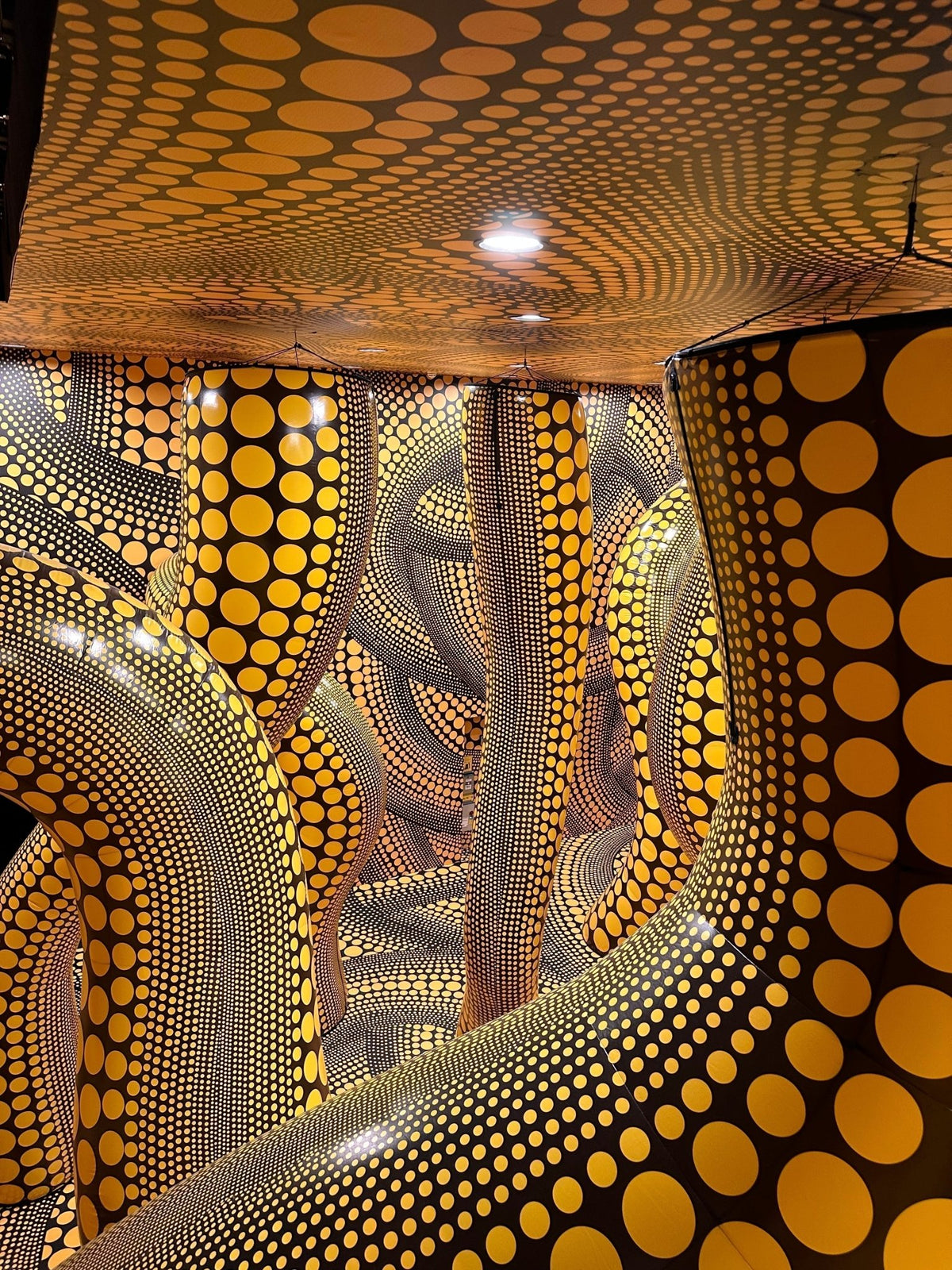
When I heard that Yayoi Kusama had died, I immediately went back to the photographs and videos from the day I took my family to see You, Me and the Balloons in Manchester in 2023.
Kusama died in Tokyo on 14 August 2026, aged 97. Her museum announced that she had continued painting until her final days. There is something rather fitting about that for an artist whose life and work became so closely intertwined.
What I remember most about seeing the exhibition isn't actually standing and looking at the art. It's how much fun we had with it.
We walked around these enormous polka-dotted forms, underneath them and between them. We explored, laughed, took photographs and interacted with the work. I had taken the family to an art exhibition, but it didn't really feel like a conventional gallery visit at all. For a while, all of us became slightly childlike.


An exhibition you didn't simply look at
You, Me and the Balloons was created for the huge spaces at Factory International in Manchester and brought together three decades of Kusama's inflatable artworks for the first time. Some of the works were more than ten metres tall.

There were enormous dolls, pumpkins, strange tendrilled landscapes and constellations of her unmistakable polka-dotted spheres. Factory International described it as Kusama's largest-ever immersive environment.
The scale was extraordinary, but what stayed with me was the freedom of the experience. Nobody needed to know anything about contemporary art before walking through the doors. You weren't being asked to stand at a prescribed distance from a canvas, read a label and move on. You could wander, explore and respond.


Looking back at our family photographs now, I understand a little more about how closely that experience connects to ideas Kusama had explored throughout her career. She repeatedly tried to break down the boundaries between the artwork, the surrounding space and the person experiencing it.
The dots were never just dots

Kusama's pumpkins and polka dots are so recognisable now that it's easy to forget the story behind them.
Born in Matsumoto, Japan, in 1929, she experienced visual and auditory hallucinations from childhood. She described patterns appearing to proliferate across her surroundings, and dots and nets began appearing in her earliest drawings.
She eventually developed the idea of self-obliteration. Through repetition, mirrors, dots, nets and endlessly multiplying forms, the boundary between the individual and the world around them could begin to disappear.
That idea followed her through an extraordinary career. Kusama moved to the United States in 1957 and became part of the New York avant-garde, creating her Infinity Net paintings, soft sculptures, mirrored installations, body-painting events, fashion shows, films and anti-war happenings.
After returning to Japan, she continued working across painting, sculpture, installation, literature and poetry. Her My Eternal Soul series alone eventually comprised around 900 paintings.
When you look at the breadth of that work, it becomes clear that this wasn't simply an artist who found a successful motif and repeated it. The dots, pumpkins and mirrors were part of a much larger visual language that she developed over decades.

Why the Manchester exhibition felt so joyful
This was probably the thing I loved most about You, Me and the Balloons. It managed to be serious contemporary art without requiring its audience to behave seriously around it.
A collector could enjoy it. A teenager could enjoy it. A child could walk in knowing absolutely nothing about Kusama and still find something exciting.
Factory International later reported that 12,500 children participated in free workshops connected with the exhibition, with another 6,500 taking part through community and schools activities. That feels very much in keeping with the exhibition I remember.
Art can sometimes make people feel that they need to understand something before they're allowed to enjoy it. Kusama's work offered an easier way in, through colour, scale, play and sheer visual spectacle.
Look beyond that spectacle and the work becomes more complicated. Throughout her career she returned to ideas around infinity, identity, anxiety, mortality and love, as well as our relationship to one another and our place within something much larger than ourselves.
I think that's why I remember taking the family so fondly. For an afternoon, art wasn't something I was trying to persuade anyone else to appreciate. We were simply experiencing it together.


Then I learned something I hadn't known
After Kusama's death, I shared some of our photographs from Manchester on Bibianna's Instagram as an Artist Spotlight and tribute to her. Someone left a comment challenging the post because of racist and anti-Black language Kusama had used in her writing.
I genuinely didn't know about it.
Given that Bibianna exists to champion African and Black artists, it wasn't something I felt comfortable brushing aside simply because it complicated my own experience of her work. So I started reading, and what I found was uncomfortable.
Kusama's writing has been criticised for racist descriptions of Black people, including passages that exoticised and hypersexualised Black bodies. Her Japanese autobiography also contained a passage associating Black residents with the deterioration of the Greenwich Village neighbourhood in which she had once lived. That passage did not appear in the later English translation.
In 2023, when the issue received renewed attention around her exhibition at SFMOMA, Kusama publicly addressed it. She said that she deeply regretted using hurtful and offensive language and apologised for the pain her words had caused.
I wish I had known that history when I originally wrote the Instagram post. I didn't, and learning about it inevitably changed the way I thought about the tribute I had just shared.
Looking at an artist's whole legacy
This is where I found myself thinking about a question that comes up repeatedly in art, literature, film and music. What happens when work that has genuinely affected us was created by someone whose behaviour or beliefs we find troubling?
I don't think pretending the work never existed is particularly satisfying. Equally, admiration for someone's art shouldn't require us to minimise the things we would rather weren't part of their story.
Kusama's contribution to post-war and contemporary art is enormous. She was a pioneering woman within the avant-garde, and her influence on installation and immersive art can be seen everywhere. Millions of people have experienced joy, curiosity and wonder through her work. My family's experience in Manchester was one tiny example of that.
It is also true that she wrote things about Black people that were racist and offensive.
When the controversy resurfaced around Kusama's SFMOMA exhibition in 2023, the museum had to grapple with many of the same questions. What stayed with me from SFMOMA's response was the idea that cultural institutions have a responsibility to present artists and their histories truthfully.
Truthfully.
I keep coming back to that word. It feels more useful than trying to sort artists neatly into people we are permitted to admire and people we aren't.
We can recognise achievement and still question it. We can enjoy a work and later learn something that changes our understanding of its maker. Most importantly, we can resist the temptation to tidy away the uncomfortable parts of an artist's history because they don't fit the story we'd previously told ourselves.
Looking back at Manchester
I still look at our photographs from You, Me and the Balloons with enormous affection.
Learning more about Kusama hasn't rewritten that afternoon. My family still played amongst those extraordinary forms. We still laughed. The work still made all of us feel slightly smaller, freer and more curious than when we walked in.
What has changed is the amount of context I now bring to those photographs.


Kusama spent more than eight decades making work and continued painting almost until the end of her 97 years. Her life and career were remarkable, influential and, as I now understand more fully, complicated.
I'm grateful that my family got to step inside a small part of the extraordinary world she created. I'm also grateful to the person who challenged my original post. I learned something because they did.
Perhaps that's another reason I continue to love art. You can walk into an exhibition thinking the experience is about what you're looking at, only to discover later that it has made you look more closely at something else entirely.
Further reading
Yayoi Kusama Official Site: Biography
Yayoi Kusama Museum: Announcement of the Passing of Yayoi Kusama
Factory International: You, Me and the Balloons


Leave a comment
This site is protected by hCaptcha and the hCaptcha Privacy Policy and Terms of Service apply.